• Skip to primary navigation
  • Skip to main content
  • Skip to primary sidebar
  • Skip to footer

MassDevice

The Medical Device Business Journal — Medical Device News & Articles | MassDevice

  • Special Reports
  • Technologies
    • Artificial Intelligence (AI)
    • Cardiovascular
    • Orthopedics
    • Neurological
    • Diabetes
    • Surgical Robotics
  • Business & Finance
    • Wall Street Beat
    • Earnings Reports
    • Funding Roundup
    • Mergers & Acquisitions
    • Initial Public Offering (IPO)
    • Legal News
    • Personnel Moves
    • Medtech 100 Stock Index
  • Regulatory
    • Food & Drug Administration (FDA)
    • Recalls
    • 510(k)
    • Pre-Market Approval (PMA)
    • MDSAP
    • Clinical Trials
  • Resources
    • About MassDevice
    • Leadership in Medtech
    • Manufacturers & Suppliers Search
    • MedTech100 Index
    • Videos
    • Webinars
    • Whitepapers
    • Voices
    • In-Depth Coverage
    • Latest News
  • Attend DeviceTalks
    • Events
      • DeviceTalks Minnesota – May 4
      • DeviceTalks Boston – May 27–28
      • DeviceTalks West
      • DeviceTalks Tuesdays
    • DeviceTalks Podcast Network
      • DeviceTalks Weekly
      • AbbottTalks
      • Boston ScientificTalks
      • DeviceTalks AI
      • IntuitiveTalks
      • MedtechWOMEN Talks
      • MedtronicTalks
      • Neuro Innovation Talks
      • Ortho Innovation Talks
      • Structural Heart Talks
      • StrykerTalks
  • Advertise
  • Subscribe
Home » FDA clears neuromod system for treating depression from Magnus Medical

FDA clears neuromod system for treating depression from Magnus Medical

September 6, 2022 By Sean Whooley

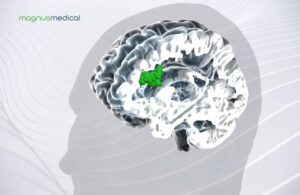
Magnus Medical Saint brain neurostimulation
[Image from Magnus Medical]
Magnus Medical announced today that it received FDA 510(k) clearance for its Saint neuromodulation system.

Burlingame, California-based Magnus designed Saint for the treatment of major depressive disorder (MDD). It treats adults who fail to achieve satisfactory improvement from prior antidepressant medications in the current episode.

The individualized, rapid-acting, non-invasive neurostimulation platform demonstrated the potential to be a reproducible, rapid and highly effective treatment for severe, refractory depression in a broader clinical setting. It received FDA breakthrough device designation in October 2021.

Saint combines advanced imaging technologies and personalized targeting and novel stimulation patterns. It uses structural and functional MRI to inform a proprietary algorithm. The algorithm identifies the optimal anatomic target for focused neurostimulation in people with MDD.

Results of a trial published in the American Journal of Psychiatry showed that 79% of people in the active treatment arm entered remission from their depression. That compared to 13% in the sham treatment arm. Magnus said in a news release that the new “individualized” neurostimulation provides a new option for treating depression.

“Today’s FDA’s clearance for the Saint neuromodulation system is a major milestone in our long-term journey to restore and sustain mental health,” said Brett Wingeier, co-founder and CEO of Magnus. “More broadly, we look forward to seeing this work make a positive impact for the millions of people affected by neuropsychiatric disease. Our clinical research program will continue to yield more insights into how personalized neuromodulation can restore healthy neural activity across a wide variety of mental health conditions.”

Wingeier said the company expects a commercial launch for Saint later in 2023. It will begin on a limited basis, he said.

“Magnus’ Saint technology is groundbreaking and could help many patients with major depressive disorder (MDD) who have not responded to treatment with antidepressants,” said Dr. Alan Schatzberg, the Kenneth T. Norris, Jr. Professor of Psychiatry and Behavioral Sciences at Stanford University, and a Past President of the American Psychiatric Association. ”The treatment effects observed with Saint treatment in the double-blinded, randomized controlled trial that was published in the American Journal of Psychiatry were dramatic, rapid, and frequently sustained through the study follow-up period.

“The technology could result in a fundamental change in the treatment approach to patients with refractory MDD and has the potential to reduce both the morbidity and mortality associated with the disorder.”


Filed Under: 510(k), Business/Financial News, Food & Drug Administration (FDA), Neurological, Neuromodulation/Neurostimulation, Regulatory/Compliance Tagged With: Magnus Medical

More recent news

  • Carlsmed names chief product and AI officer as it claims CMS reimbursements
  • Integra LifeSciences says Cincinnati plant flooding will cost millions
  • Mendaera rolls out handheld needle robot paired with Butterfly ultrasound probe
  • Edwards earns FDA approval for first-of-its-kind size-adjustable pediatric heart valve
  • Leading medical device experts and MDO launch Medtech Innovation Board

About Sean Whooley

Sean Whooley is a senior editor who mainly produces work for MassDevice, Medical Design & Outsourcing and Drug Delivery Business News. He received a bachelor's degree in multiplatform journalism from the University of Maryland, College Park. You can connect with him on LinkedIn or email him at [email protected].

Primary Sidebar

“md
EXPAND YOUR KNOWLEDGE AND STAY CONNECTED
Get the latest med device regulatory, business and technology news.

DeviceTalks Weekly

See More >
MDO ad
MDO ad

Footer

MASSDEVICE MEDICAL NETWORK

DeviceTalks
Drug Delivery Business News
Medical Design & Outsourcing
Medical Tubing + Extrusion
Drug Discovery & Development
Pharmaceutical Processing World
MedTech 100 Index
R&D World
Medical Design Sourcing

DeviceTalks Webinars, Podcasts, & Discussions

Attend our Monthly Webinars
Listen to our Weekly Podcasts
Join our DeviceTalks Tuesdays Discussion

MASSDEVICE

Subscribe to MassDevice E-Newsletter
Advertise with us
About
Contact us

Copyright © 2026 · Arrowfly LLC and its licensors. All rights reserved.
The material on this site may not be reproduced, distributed, transmitted, cached or otherwise used, except with the prior written permission of Arrowfly.

Privacy Policy