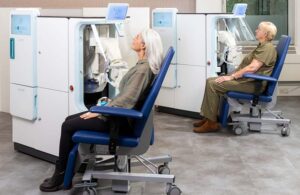
Dutch medical robotics company Vitestro developed the autonomous robotic phlebotomy device, called Aletta, to conduct every step of a blood draw, “from placing the tourniquet to applying the bandage,” the company says.
Aletta was designed to reduce workload and improve efficiency in busy laboratories, and the FDA said the device could address the current phlebotomist shortage in the U.S.
“This authorization reflects the FDA’s commitment to advancing innovative medical devices that help meet a critical public health need while maintaining the safety and effectiveness patients deserve,” said FDA Center for Devices and Radiological Health Director Dr. Michelle Tarver. “Blood draws are one of the most commonly performed medical procedures in the United States, yet patients may face delays due to a growing shortage of trained phlebotomists.”
Related: Read more about robotics in MassDevice’s 2026 Surgical Robotics Special Report
Aletta first guides the patient to position their arm, and either the patient or supervisor presses a button to initiate the procedure. Aletta uses multimodal imaging, combining near-infrared light to select a suitable vein and confirms it’s selected a vein, not an artery, with Doppler ultrasound. If Aletta doesn’t find a suitable vein, it won’t attempt a blood draw.
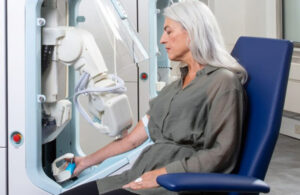
A supervising phlebotomist is required to remain nearby to respond to any issues during the process and confirms that collection tubes are filled in order and are adequately full after the procedure. One phlebotomist can oversee up to three Aletta devices at the same time.
Designed for patient safety, the needle automatically detaches and the draw stops if a patient moves too much during the procedure. Additional onboard sensors can pause the procedure and alert the supervising phlebotomist if unsafe conditions are detected, the FDA said.
FDA said its authorization is based on clinical data that “Aletta achieves successful blood draw rates comparable to or better than trained human phlebotomists” across a broad range of patients with various health statuses, patients who self-reported having difficult veins to access and patients with a variety of skin tones.
More at Medical Design & Outsourcing: How Vitestro’s first-of-its-kind Aletta robot autonomously draws blood
European clinical trial results showed a 94.5% first-stick success rate with Aletta, with 90% of patients reporting pain less than or similar to a manual human-conducted blood draw. The study also reported that mild adverse events occurred in 0.6% of patients, with no moderate or serious adverse events occurring.
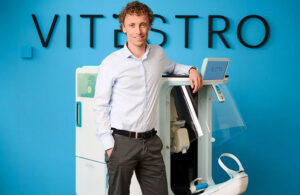
Aletta received a CE mark in 2024 and closed a $70 million oversubscribed Series B financing round in May 2026 to support broader market adoption in Europe, global commercial readiness and preparation for the U.S. market.
Vitestro’s Series B round included investments from Labcorp Venture Fund, Mayo Clinic, Fred Moll and Sonder Capital, among others.
“Vitestro is redefining one of the largest and most under-innovated clinical workflows with a first-of-its-kind autonomous robotic platform for diagnostic blood collection addressing an enormous unmet global market need,” said Fred Moll, Sonder Capital co-founder and partner and former co-founder and CEO of Intuitive Surgical. “I believe this technology has the potential to establish a new standard of care, much as robotic surgery did in its early days.”
Related: XCath raises $30M Series C to support endovascular robot, Dr. Fred Moll co-leads round
The company plans to scale up manufacturing, commercial infrastructure and initiate phased rollout planning ahead of a U.S market launch. Vitestro said it’s planning a multicenter U.S. clinical trial ahead of commercial availability to validate Aletta’s performance and safety.
Clinical evidence from the trial will support the adoption of automated phlebotomy as a scalable solution for U.S. hospitals and outpatient blood drawing laboratories, Vitestro said.