Many innovative, next-generation medical devices and components can only be made with additive manufacturing
By Tyler Stark, Senior Director of Additive Manufacturing and Innovation, Spectrum Plastics Group
Additive manufacturing (AM), also known as 3D printing, comprises an innovative suite of advanced technologies that enable the fabrication of a variety of components and products, with remarkably complex and high-resolution features which often cannot be achieved within the constraints of traditional manufacturing methods. New AM technologies, equipment, and specialized materials continue to enter the market at a rapid pace. Ultimately, advanced AM fosters creative engineering, innovative rapid prototyping, and seamless transition to high-volume manufacturing, driving medical device design forward.
Popular AM technologies include:
- Selective laser sintering (SLS)—thin layers of powdered material are fused together (also known as direct metal laser sintering and selective laser melting)
- Fused depositional modeling (FDM)—pellet or filament feedstock is dispensed through a nozzle (also known as fused filament fabrication)
- Stereolithography (SLA)—a liquid photopolymer is cured in a vat using ultraviolet light (also known as vat photo polymerization or digital light projection)
- Material jetting (Polyjet)—droplets of photosensitive material are dispensed and solidified under ultraviolet light, layer by layer
- Multi-jet fusion (MJF)—also known as binder jetting, a liquid bonding agent is selectively deposited on layers of powdered material to create a solid structure
- Direct laser metal sintering (DLMS)—also known as directed energy deposition, a laser beam or an electron beam fuses materials together by melting them as they are being deposited
Medical Applications for AM
Additive manufacturing technologies enable medical device companies to develop next-generation, innovative devices quickly, which can also be scaled to meet changing production demands.
Benefits of additive manufacturing over traditional manufacturing methods such as machining, injection molding, and extrusion include:
- Equipment and materials can be customized for a wide range of medical applications
- Rapid prototyping that delivers production-ready prototypes in a matter of days instead of weeks or months, accelerating product development and informed decision-making
- Creation of innovative, one-of-a-kind products or components, especially for minimally invasive surgical processes
- Bridge manufacturing that utilizes AM to test low-volume production runs of a product before investing heavily in a mass-production process using standard methods of manufacturing.
Proprietary/Customized Processes
AM in the medical industry continues to advance, especially the number of new AM materials with highly specific engineered properties. Software and hardware advancements also improve flow rate precision and control, achieving highly accurate parts. Depending on part geometry and complexity, tolerances can be as tight as +/-0.0005 inches.
AM has become commonplace, but with limited capabilities and offerings to incorporate high-performance thermoplastics, which can provide far more design flexibility than metals because of the vast number of thermoplastic materials available, such as acrylic, ABS, Nylon, PLA, polycarbonate, polyether sulfone, PEEK, polyethylene, urethanes, and custom materials. These materials can be altered through chemical or mechanical manipulation to improve physical properties such as impact resistance, mechanical strength, heat resistance, chemical resistance, lubricity, abrasion resistance, sterilization resistance, biocompatibility, transparency, and low water absorption.
Spectrum uses AM to process all medical-grade thermoplastic materials. Material consistency is critical for AM reliability and repeatability. To achieve the greatest control over material quality and consistency, Spectrum manufactures its own in-house filaments. All products are made from medical-grade USP Class VI and/or ISO 10993 materials and additives that are biocompatible, traceable, and certified.
Spectrum Additive Manufacturing
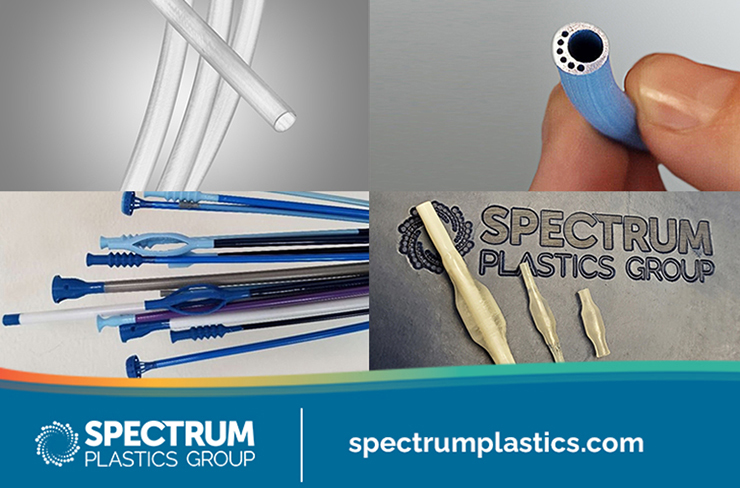
Spectrum has developed Spec+ Additive Manufacturing, its own proprietary AM equipment and processes for creating medical products that other companies cannot, such as high-precision, medical-grade single and multi-lumen tubing—a first in the industry. This proprietary technology produces prototyped multi-lumen tubing, expanding the limits of design, materials, and speed for medical-grade tubing. The Spec+ system can create a full-length multi-lumen tube to specification in a single day (in comparison, with the standard extrusion process it can take up to three or more die iterations and weeks before refining a prototype multi-lumen extrusion). Spec+ simply prints the entire extrusion profile out of the first shot of designated material.
Future Advancements
Miniaturization is a dominant trend in the medical device industry. Integrated AM processes and materials, combined with careful system controls, can produce ultra-high-precision, micro-sized parts that are suitable both for rapid prototyping and production. Spectrum AM technologies can print incredibly small parts from just about any type of thermoplastic—even multiple materials together in a single print. Parts can be so small they are often difficult to see with the naked eye.
The advantages of AM are many, including rapid prototyping, product customization, and creating intricate surface structures and textures that reduce weight and enhance performance at the micro scale. AM also does not require the expensive set-up and tooling that traditional injection molding or CNC machining requires. This also makes it easier to access bridge tooling to test short runs before making expensive investments in tools.
AM materials will continue to evolve at a rapid rate, including bioresorbable materials. Implantable components are being trialed with different AM systems to see how various materials influence product performance, especially wear and durability. Materials are also being blended together during the AM process to form “in-situ” alloys. In-situ alloys can have better mechanical properties than pre-alloyed individual metals. Plastic composites can also be formed in-situ during AM, creating exciting possibilities of improved performance.
Perhaps the greatest advantage of AM is the design freedom it provides medical device engineers, which allows them to select from a wide range of medical-grade plastics, with specifically engineered material characteristics and design components, for multi-material and multi-dimensional builds. The ultimate benefit of AM is that medical device companies can invent innovative new products that deliver vastly improved time to market.
Partner with Spectrum’s AM Technical Team
For more information about Spectrum’s advanced Spec+ additive manufacturing technologies for medical devices, visit www.spectrumplastics.com or call 404-564-8560 to speak directly with our technical experts.
Sponsored content by Spectrum Plastics Group
