• Skip to primary navigation
  • Skip to main content
  • Skip to primary sidebar
  • Skip to footer

MassDevice

The Medical Device Business Journal — Medical Device News & Articles | MassDevice

  • Special Reports
  • Technologies
    • Artificial Intelligence (AI)
    • Cardiovascular
    • Orthopedics
    • Neurological
    • Diabetes
    • Surgical Robotics
  • Business & Finance
    • Wall Street Beat
    • Earnings Reports
    • Funding Roundup
    • Mergers & Acquisitions
    • Initial Public Offering (IPO)
    • Legal News
    • Personnel Moves
    • Medtech 100 Stock Index
  • Regulatory
    • Food & Drug Administration (FDA)
    • Recalls
    • 510(k)
    • Pre-Market Approval (PMA)
    • MDSAP
    • Clinical Trials
  • Resources
    • About MassDevice
    • Leadership in Medtech
    • Manufacturers & Suppliers Search
    • MedTech100 Index
    • Videos
    • Webinars
    • Whitepapers
    • Voices
    • In-Depth Coverage
    • Latest News
  • Attend DeviceTalks
    • Events
      • DeviceTalks Minnesota – May 4
      • DeviceTalks Boston – May 27–28
      • DeviceTalks West
      • DeviceTalks Tuesdays
    • DeviceTalks Podcast Network
      • DeviceTalks Weekly
      • AbbottTalks
      • Boston ScientificTalks
      • DeviceTalks AI
      • IntuitiveTalks
      • MedtechWOMEN Talks
      • MedtronicTalks
      • Neuro Innovation Talks
      • Ortho Innovation Talks
      • Structural Heart Talks
      • StrykerTalks
  • Advertise
  • Subscribe
Home » DeviceTalks Boston: The ZimVie Tether helps kids with scoliosis — if they can get it in time

DeviceTalks Boston: The ZimVie Tether helps kids with scoliosis — if they can get it in time

May 10, 2023 By Jim Hammerand

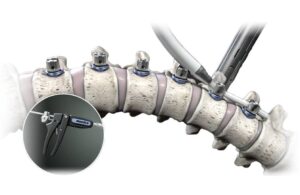
An image showing ZimVie's tether system, in which screws anchored into vertebrae of the spine are straightened with a cord running through them to treat adolescent idiopathic scoliosis.
The ZimVie Tether system is FDA approved for adolescent idiopathic scoliosis under a humanitarian device exemption. [Image courtesy of ZimVie]
The ZimVie (Nasdaq:ZIMV) Tether is a groundbreaking system for treating adolescent idiopathic scoliosis, developed with the help of surgeons who saw an opportunity to improve the lives of their pediatric patients.

But for every patient the clock is ticking, as children are only eligible if they have enough growth ahead of them for the technology to make a difference. And all too often, insurance companies can delay the treatment so long that patients are no longer eligible if and when insurers approve the procedure.

ZimVie SVP and Global Spine President Rebecca Whitney spoke about the systems development and commercialization with ZimVie Spine Global R&D Director Ryan Watson today at DeviceTalks Boston.

“We’ve worked for years to make sure that we have the right options available for these kids because it is a special patient population,” Whitney said.  “… When you talk about kids who are typically aged 10 to 15, we are hopefully improving their lives for years and years to come. We take it very seriously and it is something that all of us are very passionate about.”

What is adolescent idiopathic scoliosis?

A portrait of Rebecca Whitney, ZimVie's global spine president.
Rebecca Whitney is ZimVie’s global spine president. [Photo courtesy of ZimVie]
Adolescent idiopathic scoliosis is a curvature of the spine affecting 2-3% of the population. While diagnoses are evenly split between boys and girls, girls are eight times more likely to have curvature severe enough to require treatment.

“Idiopathic is basically code for ‘we don’t know.’ It’s not really clear as to why this happens, what creates the phenomenon,” Whitney said.

The condition can be lived with but causes issues as it progresses, including aesthetic issues and potentially life-threatening heart and lung compression. Traditional standards of care have had varying degrees of effectiveness.

“The first line of defense is a wait-and-see approach because a lot of times these curves don’t progress to the point where they do need intervention,” Whitney said. “If they do, bracing is usually the first order of treatment. Bracing can be effective, but the challenge with bracing is these kids are required to wear a brace from 12 to 20 hours a day.”

Bracing can range from uncomfortable to painful, and the biggest reason why it fails is because patients don’t want to wear them. If bracing doesn’t work, the historical standard of care is fusion.

“Posterior spinal fusion is very effective at straightening out the spine,” Whitney said. “It does that part very well, but it’s also very invasive. … You’ve got screws and rods placed all up and down the spine, and then you’re fusing that spine in place. It fixes the curvature of the spine, but it comes with long-term, potential limitations as the patient goes on to grow and continue with their active lifestyle.”

Vertebral body tethering for adolescent idiopathic scoliosis

A less-invasive alternative to fusing for adolescent idiopathic scoliosis is motion-preserving vertebral body tethering.

“Instead of fusing the back all up and down, you have these anchor points and you’re able to use basically a shoestring of sorts. And as the patient grows, that spine is able to straighten out without having to fuse the spine in place,” Whitney said. “We believe that for patients who are indicated, this is a really great solution and it offers the benefits of fusion while also preserving lifestyle. And for the most part, these kids are very active and looking to get back to a very healthy level of a lifestyle.”


Read more at our sister site, Medical Design & Outsourcing.

Filed Under: Featured, Implants, Orthopedics, Pediatrics, Spine, Surgical Tagged With: scoliosis, ZimVie

More recent news

  • Citi downgrades Boston Scientific as cyberattack recovery compounds competitive pressure
  • Autonomix taps former Medtronic FDA counsel head for board of directors
  • Medtronic strengthens robotic surgery position with Cornerstone deal, analysts say
  • Science Corp. names president as it looks to roll out vision-restoring implant
  • Mindray looks to fill hospital ventilator gap left by Philips’ exit

About Jim Hammerand

Jim Hammerand is the managing editor of Arrowfly's MassDevice and Medical Design & Outsourcing, where he leads coverage of medtech innovation, design, engineering and manufacturing. He also contributes to our Devicetalks podcasts and live events. Hammerand has more than two decades of journalism experience spanning newspapers, magazines, websites, live events, radio and TV news. For nearly a decade, Hammerand reported and edited business news for American City Business Journals as a reporter and digital editor at the Minneapolis/St. Paul Business Journal and then as managing editor of the Puget Sound Business Journal in Seattle. He holds degrees in journalism and management from the University of Minnesota and has won journalism awards from the Society of Professional Journalists, American Society of Business Publication Editors, and Trade, Association, Business Publications International. Connect with him on LinkedIn or by email at [email protected].

Primary Sidebar

Cart

“md
EXPAND YOUR KNOWLEDGE AND STAY CONNECTED
Get the latest med device regulatory, business and technology news.

DeviceTalks Weekly

See More >
MDO ad
MDO ad

Footer

MASSDEVICE MEDICAL NETWORK

DeviceTalks
Drug Delivery Business News
Medical Design & Outsourcing
Medical Tubing + Extrusion
Drug Discovery & Development
Pharmaceutical Processing World
MedTech 100 Index
R&D World
Medical Design Sourcing

DeviceTalks Webinars, Podcasts, & Discussions

Attend our Monthly Webinars
Listen to our Weekly Podcasts
Join our DeviceTalks Tuesdays Discussion

MASSDEVICE

Subscribe to MassDevice E-Newsletter
Advertise with us
About
Contact us

Copyright © 2026 · Arrowfly LLC and its licensors. All rights reserved.
The material on this site may not be reproduced, distributed, transmitted, cached or otherwise used, except with the prior written permission of Arrowfly.

Privacy Policy