
From believes the biggest issue medical technology startups face is remaining focused.
“There are a lot of early-stage life science companies that are initiated through someone that’s brilliant,” From said. “There’s so much noise coming in every day to a company… always bringing in new information that you have to learn how to filter and focus your business on.”
Sometimes, to achieve success, medtech startups need “somebody with the gray hair that understands how to figure out how to focus and get to the goal line,” From said.
Vicarious hired From to do just that, get the surgical robotics company to the goal line. From recently joined our DeviceTalks Weekly podcast and explained his business approach in getting Vicarious back on track for a targeted 2026 design freeze.
“For a company like us, we have one purpose,” From said. “You have to remember that, you have to maintain a focus on actually accomplishing that one goal.”
Download our free Surgical Robotics Special Report for more insights into the fast-growing industry.
Redefining focus
When From arrived at Vicarious, he needed to understand the company’s goal to establish his business plan, so he asked a series of questions: “Why do we exist? Is there a reason for us to exist? Why should anybody care about Vicarious?
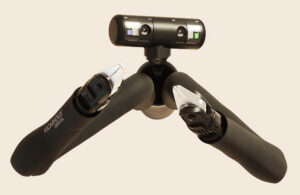
He quickly found his answer: Vicarious existed to address limitations in currently available surgical robots and laparoscopy for ventral hernia repair. From says ventral hernia repairs are mostly performed as an open surgery — not minimally invasive — due to limited movement, visualization and dexterity in available robots and laparoscopy.
Vicarious is designing its surgical robot to overcome those limitations and transform open surgeries into minimally invasive procedures, starting with ventral hernia repair. From’s business plan revolves around designing the perfect platform for this single indication, nothing more, at least not now.
Listen to our full interview with Vicarious Surgical’s CEO Stephen From on DeviceTalks Weekly.
“It just needs to be the right platform for that indication,” From said. “If we can solve that problem and get us to the goal line for doing that, that’s where our focus should be. It doesn’t need to be any more than that, even if we want it to be more. It doesn’t need to be right now.”
Designing the ‘right platform’
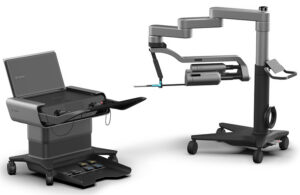
Ventral hernias appear on the ceiling of the abdominal wall, so movement, maneuvering and viewing limitations in available robotic platforms make it difficult to access different quadrants of the abdomen, view the surgical field and return to the abdominal ceiling after insertion, according to From.
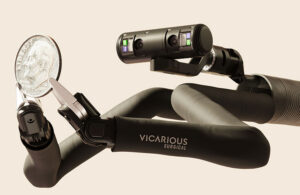
Read more about Vicarious Surgical’s robotic system design on Medical Design & Outsourcing.
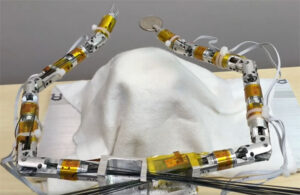
The platform includes two miniature robotic arms that move downward, sideways, upward and backward with 13° of freedom to give surgeons expanded abdominal access. Each robotic arm has 28 sensors designed to replicate a surgeon’s natural upper body movements.
The robotic arms, their instruments and a 360° camera are designed to give surgeons access and visualization through an incision smaller than a dime. Vicarious Surgical’s robot requires a 1.5 cm incision but is capable of function with incision sizes as small as 1.2 cm.
“We go in through one incision. The whole robot is in there, it can move around to all the quadrants within the abdomen,” From said. “It can go back up to the ceiling, go down to the floor. It can move all around. We don’t have those limitations.”
Engaging investors with transparency
Vicarious Surgical was plagued with development and financial setbacks in the past three years that sowed confusion and wavered levels of support among investors. When From joined the company, he said investors called asking why the robot’s timeline was delayed.
“The different stages of development … actually hadn’t been described that way to current investors,” he said. “A lot of them really misunderstood where we were in the development stage. I had to understand why they kept thinking we were delayed.”
Download our free Surgical Robotics Special Report for more insights into the fast-growing industry.
The confusion began in 2023 after Vicarious planned its first-in-human trials for mid-2024 and FDA de novo clearance submission in fiscal 2025, but then-CEO Adam Sachs pushed back the robotic platform’s timeline, citing integration challenges and impact from cost-cutting initiatives.
The company’s updated timeline planned integration in fall 2024 and de novo submission in early-to-mid-fiscal 2026.
Vicarious effected a 1-for-30 reverse stock split midway through 2024, intended to increase its per share trading price and bring the company back into compliance with the NYSE.
Months later, in May 2025, Vicarious signed a deal with UMass Memorial Medical Center to support adoption and utilization of its robotic system, signaling to investors that the company was close to bringing the technology to patients.
But, in August 2025 — the same month From joined as CEO and near the expected start of trials — From announced plans to hold off on clinical trial initiation for further product development and set a new projected design freeze date for the end of 2026.
Following a 4- to 6-week assessment of the robotic system, Vicarious successfully completed an in-vivo porcine lab in December 2025, reinforcing its progress toward a design freeze. The lab marked the first in-vivo animal cases conducted in “several years,” the company said.
Vicarious also implemented operational and cost discipline initiatives intended to streamline operating structure and significantly reduce cash burn without disrupting its development timeline for a design freeze at the end of 2026.
DeviceTalks Boston 2026: Registration is now open for our May 27-28 show
“When I started digging into [the investor confusion], I learned, unfortunately, what had been communicated publicly by the company is that we’re going to be in the clinic this year, and they’ve been hearing that for the last few years,” From said. “They hadn’t been told where we were in our development stage. But I don’t take away from management, because things were going so well with those earlier builds.”
Now as CEO, From eases investors worries with more transparency about the development timeline and reminds them about his high expectations for Vicarious’ surgical robot.
“When I talk to investors, I tell them we don’t need to think about competing against those other companies,” he said, “They have to compete against each other because the platforms are all very similar — we aren’t.”
DeviceTalks Editorial Director Tom Salemi and MassDevice Senior Editor Sean Whooley contributed to this report.