• Skip to primary navigation
  • Skip to main content
  • Skip to primary sidebar
  • Skip to footer

MassDevice

The Medical Device Business Journal — Medical Device News & Articles | MassDevice

  • Special Reports
  • Technologies
    • Artificial Intelligence (AI)
    • Cardiovascular
    • Orthopedics
    • Neurological
    • Diabetes
    • Surgical Robotics
  • Business & Finance
    • Wall Street Beat
    • Earnings Reports
    • Funding Roundup
    • Mergers & Acquisitions
    • Initial Public Offering (IPO)
    • Legal News
    • Personnel Moves
    • Medtech 100 Stock Index
  • Regulatory
    • Food & Drug Administration (FDA)
    • Recalls
    • 510(k)
    • Pre-Market Approval (PMA)
    • MDSAP
    • Clinical Trials
  • Resources
    • About MassDevice
    • Leadership in Medtech
    • Manufacturers & Suppliers Search
    • MedTech100 Index
    • Videos
    • Webinars
    • Whitepapers
    • Voices
    • In-Depth Coverage
    • Latest News
  • Attend DeviceTalks
    • Events
      • DeviceTalks Minnesota – May 4
      • DeviceTalks Boston – May 27–28
      • DeviceTalks West
      • DeviceTalks Tuesdays
    • DeviceTalks Podcast Network
      • DeviceTalks Weekly
      • AbbottTalks
      • Boston ScientificTalks
      • DeviceTalks AI
      • IntuitiveTalks
      • MedtechWOMEN Talks
      • MedtronicTalks
      • Neuro Innovation Talks
      • Ortho Innovation Talks
      • Structural Heart Talks
      • StrykerTalks
  • Advertise
  • Subscribe
Home » TCT 2012: St. Jude Medical touts PressureWire FFR cost-effectiveness study

TCT 2012: St. Jude Medical touts PressureWire FFR cost-effectiveness study

October 24, 2012 By MassDevice staff

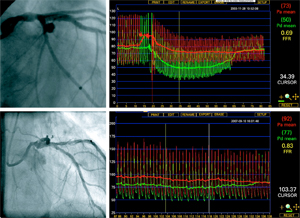
St. Jude Medical's Fame II FFR study

St. Jude Medical (NYSE:STJ) is once again touting results from its Fame II study, this time citing data showing the cost-effectiveness of its PressureWire fractional flow reserve device.

The St. Paul, Minn.-based medical device company funded the trial, comparing patients who underwent percutaneous coronary intervention guided by FFR and "optimal medical therapy" (an anti-platelet and beta blocker drug regimen) with patients treated with drug therapy alone.

St. Jude lauded earlier data from the trial in August, saying Fame II demonstrated that the FFR-guided PCI arm patients fared better than the control arm. Now the company said the data also show that the procedure is less expensive than medical therapy alone over the long term.

Using a measure called the "incremental cost-effectiveness ratio," or the ratio of the change in costs to incremental benefits of a therapy, St. Jude claimed today that the FFR-guided arm posted an ICER value of $32,000 per quality-adjusted life year, enough to mark it "highly cost effective," according to a press release.

"While FFR-guided PCI had a higher initial cost than patients treated by medical therapy alone, after 1 year the cost gap narrowed by more than 50% due to a higher number of hospital re-admissions for patients treated only with medical therapy," according to the release.

Early this year, St. Jude cut short the Fame II study due to the overwhelming success of the findings, prompting

But the shortened duration of the study poses a problem for skeptics including Dr. William Boden, who wrote an editorial for the New England Journal of Medicine, "What is More Enduring – Fame or Courage?," questioning the study’s validity due to its shortened term.

"Clearly, FFR holds potential promise for a more targeted approach to PCI that might be more clinically effective and cost-effective than visually directed PCI for all angiographically significant stenoses," Boden wrote. "Unfortunately, the early termination of the FAME II trial before full enrollment and follow-up were achieved, the neutral effects on the rate of death or myocardial infarction, and the lack of a significant, sustained treatment effect on the reduction of angina beyond 6 months leave more questions than answers."

The Fame II study proved to be important, not just for St. Jude, but for FFR rival Volcano Corp. (NSDQ:VOLC). Those companies are embroiled in a bitter patent dispute over FFR technology. The study could also help boost the sagging stents businesses of the major players in the market, Boston Scientific (NYSE:BSX), Abbott (NYSE:ABT) and Medtronic (NYSE:MDT).

Filed Under: Uncategorized Tagged With: Cardiac Rhythm Management, stjudemedical, TCT 2012

More recent news

  • Former Medtronic RDN leader joins Teleflex
  • CMR Surgical CEO outlines the path forward for Stryker’s robotics partnership
  • Stryker earns FDA clearance for new bone and soft tissue removal platform
  • MiniMed completes split from Medtronic
  • GE HealthCare’s on-site cyclotron for PET agent production claims CE Mark

Primary Sidebar

“md
EXPAND YOUR KNOWLEDGE AND STAY CONNECTED
Get the latest med device regulatory, business and technology news.

DeviceTalks Weekly

See More >
MDO ad
MDO ad

Footer

MASSDEVICE MEDICAL NETWORK

DeviceTalks
Drug Delivery Business News
Medical Design & Outsourcing
Medical Tubing + Extrusion
Drug Discovery & Development
Pharmaceutical Processing World
MedTech 100 Index
R&D World
Medical Design Sourcing

DeviceTalks Webinars, Podcasts, & Discussions

Attend our Monthly Webinars
Listen to our Weekly Podcasts
Join our DeviceTalks Tuesdays Discussion

MASSDEVICE

Subscribe to MassDevice E-Newsletter
Advertise with us
About
Contact us

Copyright © 2026 · Arrowfly LLC and its licensors. All rights reserved.
The material on this site may not be reproduced, distributed, transmitted, cached or otherwise used, except with the prior written permission of Arrowfly.

Privacy Policy