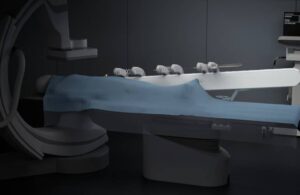
Specialist surgeons performed the procedures, guiding interventions from different hospitals in Florida and Dundee, Scotland. They performed full, end-to-end thrombectomies on perfused, non-living subjects with procedure-authentic pathology at the University of Dundee.
The company says the completed cases demonstrate its technology’s ability to save the lives and prognoses of patients suffering stroke episodes in remote settings. It could also improve critical care and outcomes for stroke patients using robotic accuracy and precision. The company also hopes to create a fully digital process with rich data to inform the next generation of specialists and endovascular robotics.
“For an ischaemic stroke, the difference between walking out of hospital and a lifetime of disability can be just two to three hours,” said Edvardas Satkauskas, co-founder and CEO of Sentante. “Today, patients are often transported long distances to reach one of a limited number of thrombectomy centres. With Sentante, the specialist comes to the patient over a secure network, and performs the entire procedure remotely—with the same tactile feel and control they have at the bedside.”
More about the Sentante procedures
Dr. Ricardo Hanel, co-medical director of the Stroke & Cerebrovascular Center performed the transatlantic procedure. He operated from Baptist Medical Center (Jacksonville, Florida) on a unique, perfused human cadaver model located at Dundee University in Scotland.
From a remote hospital in Dundee, Dr. Iris Grunwald, an interventional neuroradiologist, performed a remote stroke thrombectomy in the same location.
“We were honored to be a test site for this groundbreaking use of remote robotic technology,” said Michael A. Mayo, president and CEO of Baptist Health. “Dr. Hanel and the team here at Baptist Health provide world-class neurosurgical interventions each day, and the potential for these life-saving procedures to be delivered in a timely manner can bring new sources of hope and healing to a countless number of patients.”
The procedure also looked at network performance and latency over the transatlantic link. Sentante partnered with Mischa Dohler, VP of Emerging Technologies at Ericsson to establish multi-path connectivity to maintain a stable, secure connection for mission-critical use.
Through the Nvidia Inception Program, the company also used state-of-the-art technologies purpose-built for developing healthcare robotics. These technologies support low-latency robotic applications and future developments for autonomous robotic systems and physical AI.
Sentante says it wants to find a way to close the gap in endovascular intervention through thrombectomy. Other companies, like Remedy Robotics, are also advancing robotic thrombectomy technologies. Penumbra, Surmodics and more also develop thrombectomy technologies. Meanwhile, companies like Microbot Medical and EndoQuest Robotics also develop endovascular robotic systems.
More about what sets this robot apart and what’s next
Sentante is a haptic endovascular robotic platform using standard cath lab equipment, such as guidewires and catheters. These devices connect to a system equipped with a high-resolution sensory platform capturing the specialist’s hand movements.
A robot at the patient’s bedside replicates these manipulations in real-time, whether nearby or thousands of miles away. Unlike joystick-controlled surgical robots, it delivers authentic force feedback to the surgeon’s fingertips, the company says. This recreates the tactile experience of manual surgery.
The tele-operated system enables life-saving interventions from seated positions at high-resolution screens displaying X-ray imagery. This frees surgeons from radiation exposure and the physical strain of standing for prolonged periods.
“Sentante is a tool that changes the work environment for cath lab and patients, dramatically. This is about access and consistency,” added Satkauskas. “Access, because patients in remote or non-specialist hospitals can receive the gold-standard treatment without delay. Consistency, because robotics bring precision, stability and rich digital data that can support training and, over time, increasing levels of assistance.”
This recent demonstration follows other remote work and a clinical trial for peripheral interventions. In the trial, surgeons used the same core platform operated from a control room adjacent to the theater.
Next, Sentante wants to bring its system through regulatory pathways for peripheral vascular interventions. It expects to bring it to market in 2026. Then, it plans to extend to stroke thrombectomy and proceed through a parallel regulatory pathway.
“Remote stroke treatment is one of the strongest real-world cases in medical robotics,” said Satkauskas. “You need precision, stability, safety and teleoperation all at once. Our platform was built from day one to deliver exactly that.”