• Skip to primary navigation
  • Skip to main content
  • Skip to primary sidebar
  • Skip to footer

MassDevice

The Medical Device Business Journal — Medical Device News & Articles | MassDevice

  • Special Reports
  • Technologies
    • Artificial Intelligence (AI)
    • Cardiovascular
    • Orthopedics
    • Neurological
    • Diabetes
    • Surgical Robotics
  • Business & Finance
    • Wall Street Beat
    • Earnings Reports
    • Funding Roundup
    • Mergers & Acquisitions
    • Initial Public Offering (IPO)
    • Legal News
    • Personnel Moves
    • Medtech 100 Stock Index
  • Regulatory
    • Food & Drug Administration (FDA)
    • Recalls
    • 510(k)
    • Pre-Market Approval (PMA)
    • MDSAP
    • Clinical Trials
  • Resources
    • About MassDevice
    • Leadership in Medtech
    • Manufacturers & Suppliers Search
    • MedTech100 Index
    • Videos
    • Webinars
    • Whitepapers
    • Voices
    • In-Depth Coverage
    • Latest News
  • Attend DeviceTalks
    • Events
      • DeviceTalks Minnesota – May 4
      • DeviceTalks Boston – May 27–28
      • DeviceTalks West
      • DeviceTalks Tuesdays
    • DeviceTalks Podcast Network
      • DeviceTalks Weekly
      • AbbottTalks
      • Boston ScientificTalks
      • DeviceTalks AI
      • IntuitiveTalks
      • MedtechWOMEN Talks
      • MedtronicTalks
      • Neuro Innovation Talks
      • Ortho Innovation Talks
      • Structural Heart Talks
      • StrykerTalks
  • Advertise
  • Subscribe
Home » Recor Medical shares positive renal denervation data at TCT

Recor Medical shares positive renal denervation data at TCT

October 30, 2025 By Sean Whooley

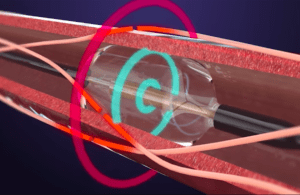
This ReCor Medical illustration shows how its Paradise renal denervation catheter system works.
This ReCor Medical illustration shows the Paradise renal denervation catheter during the procedure. The red circle indicates ultrasound-generated energy producing heat for denervation, while the blue circles illustrate cooling from circulating water within the artery to protect the artery from heat. [Image courtesy of Recor Medical]

Recor Medical today announced results from two clinical studies evaluating its Paradise ultrasound renal denervation (uRDN) system.

Tokyo-based Otsuka’s U.S.-based Recor subsidiary developed Paradise for the treatment of resistant hypertension. Recor Medical received a landmark FDA nod for its Paradise system in November 2023. It also holds CE mark.

The first-of-its-kind Paradise technology denervates the sympathetic nerves surrounding the renal arteries. This lowers blood pressure by reducing the overactivity that can lead to hypertension.

Paradise delivers two to three doses of 360-degree ultrasound energy, lasting seven seconds each. The energy travels through each of the main renal arteries to the surrounding nerves. Its catheter features the Recor HydroCooling system that circulates sterile water during the procedure to protect the renal artery wall.

At the 2025 Transcatheter Cardiovascular Therapeutics (TCT) conference in San Francisco, the company shared findings from its Global Paradise System (GPS) registry and a pooled analysis of data from its RADIANCE global clinical trial program. The positive data presentation comes just days after the company picked up a significant Medicare win as well.

“The growing body of real-world evidence continues to demonstrate the power of the Paradise uRDN system to meaningfully lower blood pressure in patients with uncontrolled and resistant hypertension,” said Lara Barghout, president and CEO of Recor Medical. “These results further strengthen the case for the Paradise uRDN system as a safe, durable, and effective treatment option and underscore the important and real impact this therapy can have on patients’ lives.”

A look at the findings shared by Recor

The GPS registry evaluates real-world patients across nine countries outside the U.S. It assesses the long-term safety and effectiveness of Paradise when used according to its labeling.

Dr. Karl Fengler (Heart Center, Leipzig, Germany) presented the findings, including the first prospective analysis of data from 212 patients, at TCT.

Findings included a reduction in office systolic blood pressure by 19.6 mmHg at six months-post procedure.Home systolic blood pressure went down by 14.4 mmHg compared to baseline. Procedure times, contrast volume and fluoroscopy time all went down compared to previous RADIANCE trials. Additionally, Recor said the cohort of patients represented a higher risk profile and higher baseline blood pressures than previous studies. The data included zero safety concerns observed.

Recor said the RADIANCE pooled analysis featured data from 24 months follow-up from 243 patients randomized in the three studies within the RADIANCE global program: RADIANCE-HTN TRIO, RADIANCE-HTN SOLO and RADIANCE II.

Dr. Ajay J. Kirtane (Columbia University, Irving Medical Center) presented the data. Findings included a 15.7 mmHG reduction in office systolic blood pressure at 24 months. This demonstrated that Paradise delivered sustained blood pressure reductions at two-year follow up. Again, investigators observed no safety concerns.

“The magnitude of reduction demonstrated in the GPS Registry data and the sustained results shown in the RADIANCE pooled analysis are clinically meaningful,” said Helen Reeve-Stoffer, chief clinical officer of Recor Medical. “The level of blood pressure reduction seen in the GPS Registry may translate into a marked decrease in cardiovascular risk for patients, and the data provide confidence for physicians in the continuity of the blood pressure reduction. The consistency of results observed across our clinical trials and real-world data reinforces the robust therapeutic value and safety of the Paradise uRDN system. We look forward to continuing to collect more real-world and long-term data.”


Filed Under: Cardiovascular, Catheters, Clinical Trials Tagged With: ReCor Medical, TCT 2025

More recent news

  • Abbott partners with Berry Street to add nutrition coaching to Lingo
  • GE HealthCare taps retiring AT&T CFO for board of directors
  • Corcym delivers first-in-human implant of Memo 4D Curve mitral repair ring
  • Boston Scientific MedSurg, Asia Pacific leader to retire
  • DePuy Synthes launches next-generation automated fracture fixation system

About Sean Whooley

Sean Whooley is a senior editor who mainly produces work for MassDevice, Medical Design & Outsourcing and Drug Delivery Business News. He received a bachelor's degree in multiplatform journalism from the University of Maryland, College Park. You can connect with him on LinkedIn or email him at [email protected].

Primary Sidebar

Cart

“md
EXPAND YOUR KNOWLEDGE AND STAY CONNECTED
Get the latest med device regulatory, business and technology news.

DeviceTalks Weekly

See More >
MDO ad
MDO ad

Footer

MASSDEVICE MEDICAL NETWORK

DeviceTalks
Drug Delivery Business News
Medical Design & Outsourcing
Medical Tubing + Extrusion
Drug Discovery & Development
Pharmaceutical Processing World
MedTech 100 Index
R&D World
Medical Design Sourcing

DeviceTalks Webinars, Podcasts, & Discussions

Attend our Monthly Webinars
Listen to our Weekly Podcasts
Join our DeviceTalks Tuesdays Discussion

MASSDEVICE

Subscribe to MassDevice E-Newsletter
Advertise with us
About
Contact us

Copyright © 2026 · Arrowfly LLC and its licensors. All rights reserved.
The material on this site may not be reproduced, distributed, transmitted, cached or otherwise used, except with the prior written permission of Arrowfly.

Privacy Policy