As he pioneers nanosecond pulsed field ablation, Pulse BioSciences’ CTO knows what it takes to create successful, innovative medtech for the best patient outcome. Sometimes, it takes partnering with the competition.
Sometimes, success requires integration and partnership with the competition.

Uecker’s strategy has led four medtech companies he’s worked with toward acquisition. The first was acquired by Intuitive Surgical.
As an engineer turned C-suite executive with almost 33 years of medtech experience spanning across robotics, oncology, gynecology and cardiology, Uecker knows what it takes to bring novel technology from benchtop to commercialization, and all the fundraising, patents and marketing in between.
Nanosecond pulsed-field ablation (nsPFA) technology might be new, but the strategy he established three decades ago remains the same.
Early innovation and partnering with the competition
Uecker never planned to build a career in medtech. He had a robotics background, and was looking for applications for his work when a few of his peers at the University of California, Santa Barbara founded Computer Motion.
When the company was founded in 1989, the surgical robotics industry was heating up. The team of roboticists didn’t have an understanding of medical device development and had never been in an operating room, Uecker said, but they knew the technology.
“[We] had to take that technology and learn on the fly everything you need to learn when you develop medical devices,” Uecker said on our DeviceTalks weekly podcast.
A few years later, Computer Motion developed the first FDA-approved surgical robot, a voice-controlled robotic arm equipped with an endoscope, called AESOP (automated endoscopic system for optimal positioning). The first-of-its-kind technology allowed surgeons to maneuver the endoscope attached to a robotic arm using voice commands.
More on Medical Design & Outsourcing: Is nanosecond pulsed field ablation the next big step for PFA?
“It came from a technology base and then met the application,” Uecker said. “[Then we] brought in physicians, and that really helped connect the technology to the medical field and operating room.”
Computer Motion accelerated the robotics race with Zeus, a complete telemanipulator surgical robotics system. Zeus demonstrated feasibility of remote surgery and flexibility for one platform to be used in a variety of applications, marking a new era in robotic surgery. But, the competition wasn’t far behind; Intuitive was about to debut its da Vinci system.
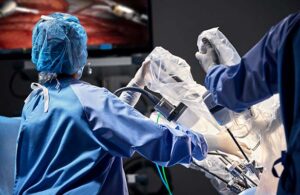
“The competition was fierce between the companies — on the technology side, on the sales and marketing side and in patent litigation.”
Before Computer Motion and Intuitive could bring next-generation technology to patients, both companies feuded on who owned the technology’s intellectual property (IP). In technology-driven industries, a company that owns a technology’s IP could control the market, leading to tense legal battles.
Intuitive struck first, filing a joint lawsuit with IBM against Computer Motion alleging patent infringement of one of IBM’s patents which Intuitive held an exclusive license. Then Computer Motion filed a suit, claiming that Intuitive infringed on nine of its U.S. patents.
“We had to beat each other up a little bit before figuring out that if we keep beating each other up, someone else could enter this market without the battle scars and compete against us,” Uecker said.
After years of litigation, Uecker said the two companies’ management team met to find a solution that would advance the surgical robotics market and bring the technology to patients faster. Uecker acknowledged that the time spent competing in court made both companies less efficient and effective, so he proposed they merge into one.
“Why not join forces and really build an impenetrable moat around this technology; with the technology itself, the IP and everything else?” Uecker said.
Committing to merge wasn’t a quick decision by either company, Uecker said, but in 2003, Intuitive acquired Computer Motion and its technology.
Uecker stood true to his mission to create technology that drives good patient outcomes. He understood his company’s strengths, his competitors’ strengths and what they could accomplish together.
“Thinking about what’s in the best interest for the future of this technology and belief in this technology in the industry,” Uecker said. “That’s really what drove [this] combination.”
Building reputation through experience and success
Over the following 11 years, Uecker established his reputation as a key player in numerous medtech startups across a range of medical specialties and technologies. He refined his strategy through experience in and outside of his wheelhouse; leading research and development teams and serving on advisory boards before becoming the president and CEO of Gynesonics.
“I felt like this was an opportunity to use my skills on the product development and technology side by running the company,” Uecker said. “[And] build additional skills fundraising and marketing the company and business development.”
Click here for a free download of MDO’s Nitinol Innovation Special Report
Uecker implemented his trusted strategy at Gynesonics: building a platform with vast capabilities, driving product development without focusing too much on an exit strategy and acquisition will come. And it did.
After developing a device that combined ultrasound imaging with radiofrequency (RF) ablation to treat uterine fibroids, Hologic acquired Gynesonics for approximately $350 million.
Today, Uecker serves as CTO of Pulse Biosciences.
The company recruited Uecker and his expertise to transform its nanosecond pulse field ablation technology into a platform with a variety of applications, and he knew exactly the strategy to employ.
Step 1: Build a platform with vast capabilities
Uecker understood the technology behind ablation, and in Pulse’s new energy modality, he saw an opportunity for applications throughout the body, not just the heart.
“A lot of medtech companies start with a singular application, [a] very focused single indication,” Uecker said. “Maybe even with an eye towards strategies that would be interested in acquiring and putting it in their channel.”
Step 2: Be diligent in developing intellectual property
Uecker learned early in his career how crucial it is to secure early IP on core technology to drive innovation and development.
As the technology moves into clinical settings, it’s tested to solve issues it’s unfamiliar with or issues that haven’t been addressed. When issues arise, the technology develops; often beyond the initial patent.
“It’s very important in those early days to make sure you’re focused on [developments] in the IP and [secure] patents specifically around those different developments,” Uecker said.
Step 3: Focus on product development and cultivate partnership to advance design
Uecker views Pulse’s nanosecond PFA technology as “second generation” since most PFA technology available today is in the microsecond domain. He understands the importance of creating partnerships that lead to integration to create the most innovative technology for positive patient outcomes.
“It requires the integration of different products, different technologies,” Uecker said. “On the ablation side, integrating tightly with a mapping and navigation system, such as the EnSite X system from Abbott or the Carto system from Johnson & Johnson, can provide the kind of solution that electrophysiologists expect, and will help drive great outcomes.”
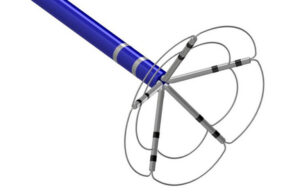
At the Annual AF Symposium in 2026, Pulse featured its new cardiac catheter with a novel integration with Abbott’s EnSite X mapping system during a live broadcast. The collaboration was very well received, Uecker said, reinforcing his unique, collaborative strategy.
“We recognize what we’re really good at, what our technology is really good at, and where it makes sense to partner, to leverage what other people are good at,” Uecker said. “And [then] drive a really great solution.”