• Skip to primary navigation
  • Skip to main content
  • Skip to primary sidebar
  • Skip to footer

MassDevice

The Medical Device Business Journal — Medical Device News & Articles | MassDevice

  • Special Reports
  • Technologies
    • Artificial Intelligence (AI)
    • Cardiovascular
    • Orthopedics
    • Neurological
    • Diabetes
    • Surgical Robotics
  • Business & Finance
    • Wall Street Beat
    • Earnings Reports
    • Funding Roundup
    • Mergers & Acquisitions
    • Initial Public Offering (IPO)
    • Legal News
    • Personnel Moves
    • Medtech 100 Stock Index
  • Regulatory
    • Food & Drug Administration (FDA)
    • Recalls
    • 510(k)
    • Pre-Market Approval (PMA)
    • MDSAP
    • Clinical Trials
  • Resources
    • About MassDevice
    • Leadership in Medtech
    • Manufacturers & Suppliers Search
    • MedTech100 Index
    • Videos
    • Webinars
    • Whitepapers
    • Voices
    • In-Depth Coverage
    • Latest News
  • Attend DeviceTalks
    • Events
      • DeviceTalks Minnesota – May 4
      • DeviceTalks Boston – May 27–28
      • DeviceTalks West
      • DeviceTalks Tuesdays
    • DeviceTalks Podcast Network
      • DeviceTalks Weekly
      • AbbottTalks
      • Boston ScientificTalks
      • DeviceTalks AI
      • IntuitiveTalks
      • MedtechWOMEN Talks
      • MedtronicTalks
      • Neuro Innovation Talks
      • Ortho Innovation Talks
      • Structural Heart Talks
      • StrykerTalks
  • Advertise
  • Subscribe
Home » Philips says preliminary data backs its ultrasound tech’s mitral regurgitation tracking

Philips says preliminary data backs its ultrasound tech’s mitral regurgitation tracking

September 2, 2026 By Sophie Carite

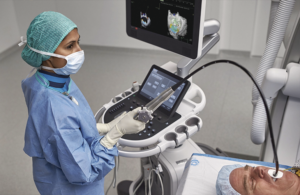
This is a Philips marketing image showing a health provider using its AI-powered, ultrasound-based system to measure mitral regurgitation.
Preliminary data from Philips back its AI-powered, ultrasound-based 3D Auto Color Flow Quantification (CFQ) technology for measuring mitral regurgitation. [Image from Philips]

Philips (NYSE: PHG) shared new clinical data supporting its AI-powered 3D Auto Color Flow Quantification (CFQ) technology for measuring mitral regurgitation.

Mitral regurgitation is a common heart condition in which the mitral valve does not close tightly, allowing blood to leak or flow backward. This can lead to a number of risks for the patient, including heart failure and death.

To plan timely treatment, an accurate assessment of blood flow and disease severity is essential, according to a Philips news release posted yesterday.

In an ongoing, multicenter international study, investigators have been comparing Philips technology to the traditional quantitative approaches using cardiac magnetic resonance imaging to confirm accuracy.

Findings so far — shared last week at the European Society of Cardiology Congress — suggest that Philips’ new approach may make it easier to assess and monitor patients with mitral regurgitation over time.

The 3D Auto CFQ algorithm works by using transesophageal echocardiography, an ultrasound test that creates images of the heart from a device inside the esophagus, to reconstruct and track the regurgitant convergence zone when the heart muscles contract.

Current recommended approaches, like the two-dimensional proximal isovelocity surface area (PISA) method analyzed in the study, rely on geometric assumptions and single-frame measurements, which can limit accuracy, according Philips.

Philips 3D technology accounts for changes in regurgitant orifice area and multiple regurgitant jets, giving a more comprehensive understanding of the amount of blood leaking from the valve.

By deepening and hastening clinicians’ understanding of the patient’s condition, Philips’ new technology may support faster care decisions in cases where disease presentation previously made this more difficult, according to the news release.

“Accurate quantification of mitral regurgitation is essential for clinical decision making, yet conventional approaches have well-recognized limitations,” said Dr. Victoria Delgado, MD, PhD, Hospital University Germans Trias i Pujol in Badalona, Spain, in a news release. “By providing measurements that more closely match cardiac magnetic resonance than conventional 2D PISA-based methods, these findings suggest AI-powered 3D Auto CFQ may help clinicians more consistently quantify mitral regurgitation across a wider variety of disease presentation.”

Filed Under: Cardiovascular, Clinical Trials, Digital Health, Imaging, Ultrasound Tagged With: Philips

More recent news

  • Abbott rolls out SimpleScreen colorectal cancer blood test developed by Freenome
  • Terumo to buy Arsenal Medical and its liquid embolic brain bleed system
  • MassDevice parent Arrowfly is launching AI for Engineers
  • Smart ring maker Oura postpones anticipated IPO
  • Medtronic gains regulatory wins for latest cardiac ablation software

Primary Sidebar

Cart

“md
EXPAND YOUR KNOWLEDGE AND STAY CONNECTED
Get the latest med device regulatory, business and technology news.

DeviceTalks Weekly

See More >
MDO ad
MDO ad

Footer

MASSDEVICE MEDICAL NETWORK

DeviceTalks
Drug Delivery Business News
Medical Design & Outsourcing
Medical Tubing + Extrusion
Drug Discovery & Development
Pharmaceutical Processing World
MedTech 100 Index
R&D World
Medical Design Sourcing

DeviceTalks Webinars, Podcasts, & Discussions

Attend our Monthly Webinars
Listen to our Weekly Podcasts
Join our DeviceTalks Tuesdays Discussion

MASSDEVICE

Subscribe to MassDevice E-Newsletter
Advertise with us
About
Contact us

Copyright © 2026 · Arrowfly LLC and its licensors. All rights reserved.
The material on this site may not be reproduced, distributed, transmitted, cached or otherwise used, except with the prior written permission of Arrowfly.

Privacy Policy