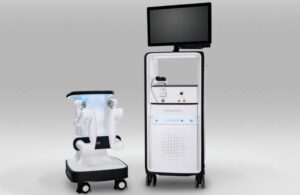
Johnson & Johnson MedTech (NYSE: JNJ) today announced results from a study of its Monarch platform for robotic bronchoscopy procedures.
Results from the TARGET study showed that clinicians could reach small and peripherally located lung nodules in more than 98% of cases with Monarch. They also biopsied those nodules with a safety profile compared to non-robotic bronchoscopy procedures. Investigators published findings in the journal CHEST.
TARGET looked at 679 patients across 21 global sites in the U.S., Canada and Hong Kong, Johnson & Johnson MedTech said. The study aimed to measure safety, navigation success and diagnostic yield across a broad range of patients in a real-world setting. Investigators reported reaching the lesion with Monarch in 98.7% of cases and a diagnostic yield of 83.2%.
For more on the wide world of surgical robotics, see our special report on the space.
Additionally, investigators noted learnings about variables significantly associated with higher diagnostic yield. Those include history of chronic obstructive pulmonary disease (COPD)/emphysema and presence of a bronchus sign. Investigator Dr. Faisal Khan said the results “can help raise awareness of robotic-assisted bronchoscopy as a safe, effective option.” Khan says it could raise the standard of care for patients.
Monarch enables the use of minimally invasive, robotic-assisted technology for peripheral lung procedures. This could improve the ability to access small, hard-to-reach peripheral lung nodules at an earlier stage and with greater precision.
“Johnson & Johnson is committed to generating evidence that demonstrates the safety and efficacy of our products and advances innovation in areas with significant unmet needs,” said Dr. Ray Fryrear, VP of Scientific Affairs for Robotics and Digital at Johnson & Johnson MedTech. “As the pioneers in the field of robotic-assisted bronchoscopy, we are committed to evolving its potential to change the way clinicians diagnose and treat lung cancer.”