• Skip to primary navigation
  • Skip to main content
  • Skip to primary sidebar
  • Skip to footer

MassDevice

The Medical Device Business Journal — Medical Device News & Articles | MassDevice

  • Special Reports
  • Technologies
    • Artificial Intelligence (AI)
    • Cardiovascular
    • Orthopedics
    • Neurological
    • Diabetes
    • Surgical Robotics
  • Business & Finance
    • Wall Street Beat
    • Earnings Reports
    • Funding Roundup
    • Mergers & Acquisitions
    • Initial Public Offering (IPO)
    • Legal News
    • Personnel Moves
    • Medtech 100 Stock Index
  • Regulatory
    • Food & Drug Administration (FDA)
    • Recalls
    • 510(k)
    • Pre-Market Approval (PMA)
    • MDSAP
    • Clinical Trials
  • Resources
    • About MassDevice
    • Leadership in Medtech
    • Manufacturers & Suppliers Search
    • MedTech100 Index
    • Videos
    • Webinars
    • Whitepapers
    • Voices
    • In-Depth Coverage
    • Latest News
  • Attend DeviceTalks
    • Events
      • DeviceTalks Minnesota – May 4
      • DeviceTalks Boston – May 27–28
      • DeviceTalks West
      • DeviceTalks Tuesdays
    • DeviceTalks Podcast Network
      • DeviceTalks Weekly
      • AbbottTalks
      • Boston ScientificTalks
      • DeviceTalks AI
      • IntuitiveTalks
      • MedtechWOMEN Talks
      • MedtronicTalks
      • Neuro Innovation Talks
      • Ortho Innovation Talks
      • Structural Heart Talks
      • StrykerTalks
  • Advertise
  • Subscribe
Home » Catheter delivery could enable better brain implants: Synchron’s neuroscience chief explains how

Catheter delivery could enable better brain implants: Synchron’s neuroscience chief explains how

April 12, 2022 By Jim Hammerand

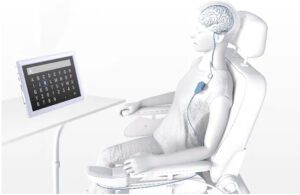
Synchron Stentrode brain-computer interface BCI system catheter delivery
The Synchron brain-computer interface system relays signals from the brain to a device in the chest, then translates the signals into action on a computer. [Image courtesy of Synchron]

Synchron’s catheter delivery could make brain-computer interface technology simpler, safer and more accessible than the leading alternative: open-brain surgery.

Officials at Synchron — developer of the catheter-delivered Stentrode brain-computer interface (BCI) implant — believe they’re the only BCI company tapping into blood vessels to capture signals from the brain.

They say they’ve already enabled a small group of paralyzed ALS patients to control a computer with their minds, and hope there will be more technology applications.

Shortly after the New York–based company released new results of a safety study for its implant, Synchron Director of Neuroscience Peter Yoo spoke with Medical Design & Outsourcing about the Stentrode implant and how catheter delivery could make BCI technology simpler, safer and more accessible than the leading alternative: open-brain surgery.

“The novel approach of the catheter delivery increases the number of physicians who can deliver our devices compared to a very specialized type of surgery,” Yoo said in an interview. “The techniques that we use are standard angiography procedures and other neurointerventional techniques performed by stroke doctors. We’re hoping that it’ll help with the proliferation of the technology and access to the technology, that it can be cheaper and more available for the patients who are in need.”


Go to our sister site Medical Design & Outsourcing to check out the conversation, edited for space and clarity.

Filed Under: Bioelectronic Medicine, Catheters, Featured, Neurological, Neuromodulation/Neurostimulation, News Well Tagged With: brain stimulation, brain-computer interface, Synchron

More recent news

  • Citi downgrades Boston Scientific as cyberattack recovery compounds competitive pressure
  • Autonomix taps former Medtronic FDA counsel head for board of directors
  • Medtronic strengthens robotic surgery position with Cornerstone deal, analysts say
  • Science Corp. names president as it looks to roll out vision-restoring implant
  • Mindray looks to fill hospital ventilator gap left by Philips’ exit

About Jim Hammerand

Jim Hammerand is the managing editor of Arrowfly's MassDevice and Medical Design & Outsourcing, where he leads coverage of medtech innovation, design, engineering and manufacturing. He also contributes to our Devicetalks podcasts and live events. Hammerand has more than two decades of journalism experience spanning newspapers, magazines, websites, live events, radio and TV news. For nearly a decade, Hammerand reported and edited business news for American City Business Journals as a reporter and digital editor at the Minneapolis/St. Paul Business Journal and then as managing editor of the Puget Sound Business Journal in Seattle. He holds degrees in journalism and management from the University of Minnesota and has won journalism awards from the Society of Professional Journalists, American Society of Business Publication Editors, and Trade, Association, Business Publications International. Connect with him on LinkedIn or by email at [email protected].

Primary Sidebar

Cart

“md
EXPAND YOUR KNOWLEDGE AND STAY CONNECTED
Get the latest med device regulatory, business and technology news.

DeviceTalks Weekly

See More >
MDO ad
MDO ad

Footer

MASSDEVICE MEDICAL NETWORK

DeviceTalks
Drug Delivery Business News
Medical Design & Outsourcing
Medical Tubing + Extrusion
Drug Discovery & Development
Pharmaceutical Processing World
MedTech 100 Index
R&D World
Medical Design Sourcing

DeviceTalks Webinars, Podcasts, & Discussions

Attend our Monthly Webinars
Listen to our Weekly Podcasts
Join our DeviceTalks Tuesdays Discussion

MASSDEVICE

Subscribe to MassDevice E-Newsletter
Advertise with us
About
Contact us

Copyright © 2026 · Arrowfly LLC and its licensors. All rights reserved.
The material on this site may not be reproduced, distributed, transmitted, cached or otherwise used, except with the prior written permission of Arrowfly.

Privacy Policy