• Skip to primary navigation
  • Skip to main content
  • Skip to primary sidebar
  • Skip to footer

MassDevice

The Medical Device Business Journal — Medical Device News & Articles | MassDevice

  • Special Reports
  • Technologies
    • Artificial Intelligence (AI)
    • Cardiovascular
    • Orthopedics
    • Neurological
    • Diabetes
    • Surgical Robotics
  • Business & Finance
    • Wall Street Beat
    • Earnings Reports
    • Funding Roundup
    • Mergers & Acquisitions
    • Initial Public Offering (IPO)
    • Legal News
    • Personnel Moves
    • Medtech 100 Stock Index
  • Regulatory
    • Food & Drug Administration (FDA)
    • Recalls
    • 510(k)
    • Pre-Market Approval (PMA)
    • MDSAP
    • Clinical Trials
  • Resources
    • About MassDevice
    • Leadership in Medtech
    • Manufacturers & Suppliers Search
    • MedTech100 Index
    • Videos
    • Webinars
    • Whitepapers
    • Voices
    • In-Depth Coverage
    • Latest News
  • Attend DeviceTalks
    • Events
      • DeviceTalks Minnesota – May 4
      • DeviceTalks Boston – May 27–28
      • DeviceTalks West
      • DeviceTalks Tuesdays
    • DeviceTalks Podcast Network
      • DeviceTalks Weekly
      • AbbottTalks
      • Boston ScientificTalks
      • DeviceTalks AI
      • IntuitiveTalks
      • MedtechWOMEN Talks
      • MedtronicTalks
      • Neuro Innovation Talks
      • Ortho Innovation Talks
      • Structural Heart Talks
      • StrykerTalks
  • Advertise
  • Subscribe
Home » Adhesive respiratory monitor detects breathing problems early

Adhesive respiratory monitor detects breathing problems early

July 25, 2018 By Danielle Kirsh

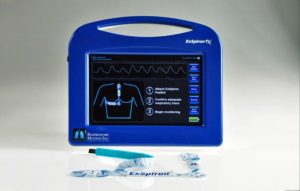
exspiron
[Image from Exspiron]
Children can be at risk for compromised breathing after surgery or from conditions like asthma, congestive heart failure or sleep apnea. Opioid therapy and sedation for medical procedures can also depress breathing. Unless a child is sick enough to have a breathing tube, respiratory problems can be difficult to detect early. Yet early detection can mean the difference between life and death.

“There is currently no real-time objective measure,” says Viviane Nasr, MD, an anesthesiologist with Boston Children’s Hospital’s Division of Cardiac Anesthesia. “Instead, respiratory assessment relies on oximetry data, a late indicator of respiratory decline, and on subjective clinical assessment.”

A new device, recently cleared by the FDA for children 1 year and older in medical settings, provides an easy, noninvasive way to tell how much air the lungs are receiving in real time. It can signal problems as much as 15-30 minutes before standard pulse oximetry picks up low blood oxygenation, according to one study.

A wearable watchdog

Called ExSpiron, the device is essentially a wearable attached to a monitor. A pair of disposable electrodes stick onto the child’s chest and, similar to body fat measurements, send a small current through the chest. The device detects the amount of impedance or resistance the current encounters and thereby calculate the volume of air in the lungs with each breath.

ExSpiron was originally developed for adults. To encourage its adaptation for the much smaller pediatric market, the Innovation and Digital Health Accelerator at Boston Children’s Hospital provided support via the FDA-funded Boston Pediatric Device Consortium (BPDC).

A study led by Nasr, published in December in Anesthesia and Analgesia, tested the device in 72 children who received general anesthesia with endotracheal intubation. ExSpiron measurements agreed well with “gold standard” measurements from an in-line monitoring spirometer.

Read the full blog post: “Stick-on respiratory monitor allows early detection of breathing problems” on Vector Blog

The opinions expressed in this blog post are the author’s only and do not necessarily reflect those of MassDevice.com or its employees.


Filed Under: Blog Tagged With: Vector Blog

More recent news

  • Sequel Med Tech’s automated twiist pump scores FDA clearance in type 2 diabetes
  • FDA posts alert for Edwards Lifesciences mitral valve delivery system after patient death
  • Former Medtronic RDN leader joins Teleflex
  • CMR Surgical CEO outlines the path forward for Stryker’s robotics partnership
  • Stryker earns FDA clearance for new bone and soft tissue removal platform

About Danielle Kirsh

Danielle Kirsh is an award-winning journalist and senior editor for Medical Design & Outsourcing, MassDevice, and Medical Tubing + Extrusion, and the founder of Women in Medtech and lead editor for Big 100. She received her bachelor's degree in broadcast journalism and mass communication from Norfolk State University and is pursuing her master's in global strategic communications at the University of Florida. You can connect with her on Twitter and LinkedIn, or email her at [email protected].

Primary Sidebar

“md
EXPAND YOUR KNOWLEDGE AND STAY CONNECTED
Get the latest med device regulatory, business and technology news.

DeviceTalks Weekly

See More >
MDO ad
MDO ad

Footer

MASSDEVICE MEDICAL NETWORK

DeviceTalks
Drug Delivery Business News
Medical Design & Outsourcing
Medical Tubing + Extrusion
Drug Discovery & Development
Pharmaceutical Processing World
MedTech 100 Index
R&D World
Medical Design Sourcing

DeviceTalks Webinars, Podcasts, & Discussions

Attend our Monthly Webinars
Listen to our Weekly Podcasts
Join our DeviceTalks Tuesdays Discussion

MASSDEVICE

Subscribe to MassDevice E-Newsletter
Advertise with us
About
Contact us

Copyright © 2026 · Arrowfly LLC and its licensors. All rights reserved.
The material on this site may not be reproduced, distributed, transmitted, cached or otherwise used, except with the prior written permission of Arrowfly.

Privacy Policy